Capture where data is born
Each site reads its own PLCs, RTUs and meters over Modbus, OPC UA, Siemens S7, EtherNet/IP or IEC 104, and keeps logging its history while the link is down.
 Data Orchesterby Amtiri
Your plant generates millions of data points every second - PLC tags, sensor readings, alarms, machine states. Data Orchester captures them at every site, decides and acts: it writes setpoints and commands back to your controllers and links every site to the control room in real time, on infrastructure you control.
Install Data Orchester in the control room and at each site. Every installation captures and controls its own plant, and keeps doing so if the link drops. Between them, values travel the moment they change, commands reach any site, and history catches up as soon as a link returns.
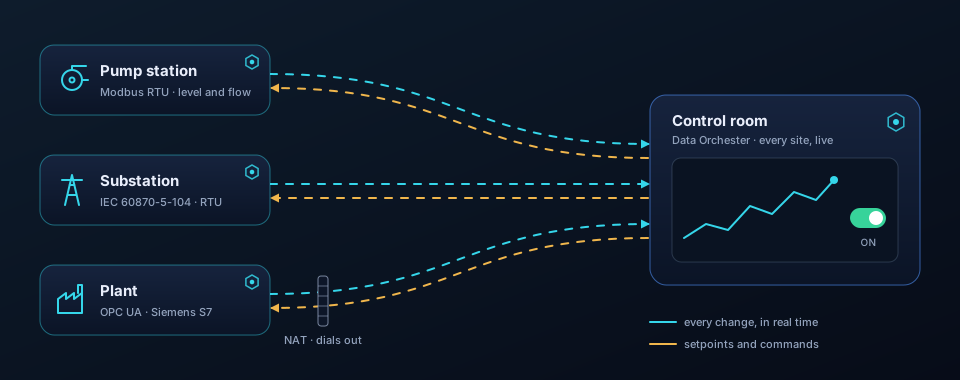
Each site reads its own PLCs, RTUs and meters over Modbus, OPC UA, Siemens S7, EtherNet/IP or IEC 104, and keeps logging its history while the link is down.
Every change is pushed to the other side the moment it happens, in signed requests. A site behind NAT or on an outbound-only network dials out, so it needs no public address.
The control room sends setpoints and commands to any site, and that site's own modules drive the devices. Each site decides which of its variables others may write.
How installations link → Satelite, the uncapped edition for your sites →
OT/IT silos, alarm latency and fragile PLC integrations are the three barriers between your plant floor and your decisions. Data Orchester removes all three, and closes the loop: it acts on the plant, not only watches it.
01
It does not matter where your signals come from - Data Orchester speaks the language of your automation systems.
02
A reactive engine sits at the heart of the system: it evaluates every change the moment it arrives and sends the result back to the plant.
03
Dashboards your operators act from, not only look at, on every device they use.
The same engine, the same activation flow - shaped to the control and monitoring needs your sector actually has.
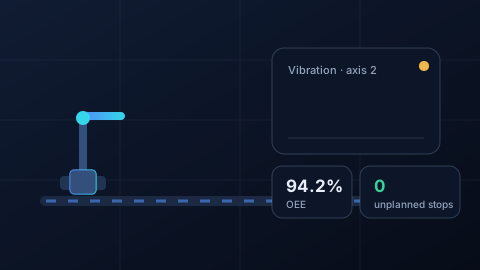
Track vibration and temperature with time-series checks you define, act before a drift becomes a failure, and watch line efficiency second by second.
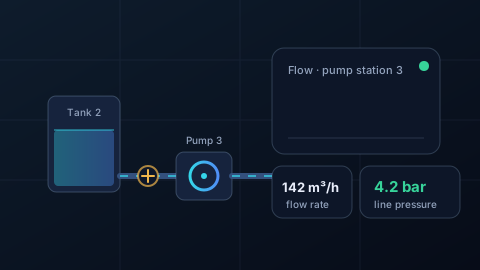
Monitor flow, pressure and tank levels across pump stations and treatment plants, and drive pumps and valves automatically the moment a threshold is crossed.
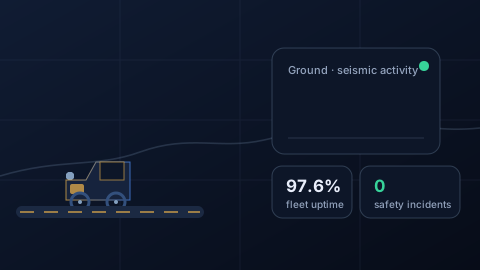
Track ground vibration and fleet health across remote sites, and act on drift before it becomes downtime or a safety incident.
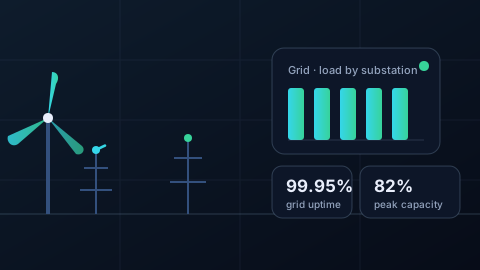
Speak IEC 60870-5-104 to substations and RTUs, watch grid load and asset uptime substation by substation, and send commands from the control room.
Every plant floor generates millions of signals every second: PLC tags, sensor readings, alarms, machine states. But is your control room actually seeing them in real time, and acting on them?
Most industrial operations struggle with:
Data Orchester removes these barriers. It is the unified platform for industrial automation control and monitoring — it connects your sensors, PLCs and controllers, and turns their signals into live monitoring and automated control, on-premise, in a private cloud, or across both.
It is designed to control, not only to monitor and display. Data Orchester reads your PLCs, RTUs and sensors, decides with formulas and PID, PWM and Kalman functions, and writes setpoints and commands back over the same protocols. Your SCADA can command it through its own OPC UA, Modbus and IEC 104 servers, and your operators act straight from its dashboards.
And it is distributed. Install it in the control room and at every site: each installation captures and controls its own plant, and they exchange values, commands and history in real time. A site behind NAT simply dials out.
Designed for demanding automation and OT teams, but friendly to the business side.
| Feature | Detail |
|---|---|
| Industrial protocols | Modbus TCP and RTU (master and slave), OPC UA (client and server), Siemens S7, EtherNet/IP and IEC 60870-5-104 (client and server), reading and writing |
| Control | Formulas and visual blocks with PID, PWM and Kalman functions; logic modules; setpoints and commands written back to the plant; switches, buttons and sliders on dashboards |
| Distributed | Installations linked site to site: every change pushed in real time, setpoints and commands to any site, history replication that catches up after an outage, sites behind NAT that dial out; every exchange signed, and each site chooses what others may write |
| Integration | A signed REST API and outbound HTTP calls for SCADA, MES, ERP and cloud systems |
| Modularity | Every connection, logic block, logger and peer link is a module, added and configured from the browser |
| Operations | Every module reports its status and messages; chosen records export and import between installations |
| Deployment | One install package for Linux and macOS (x64 and arm64) and Windows (x64), or a container image for amd64 and arm64: on-premise, in your private cloud, or both |
| Security | HTTPS built in or behind your reverse proxy; OPC UA Sign and SignAndEncrypt; signed peer links; sign-in with local accounts, LDAP/Active Directory, OpenID Connect or SAML through a broker; roles that separate configuration from security administration |
| Licensing | Free, Satelite or Full - permanent, monthly or a prepaid term |
Every edition runs the same engine and the same activation flow — only the limits and the features differ.
Download the platform and run it on your own infrastructure, or talk to an engineer about a deployment shaped around your control systems.